
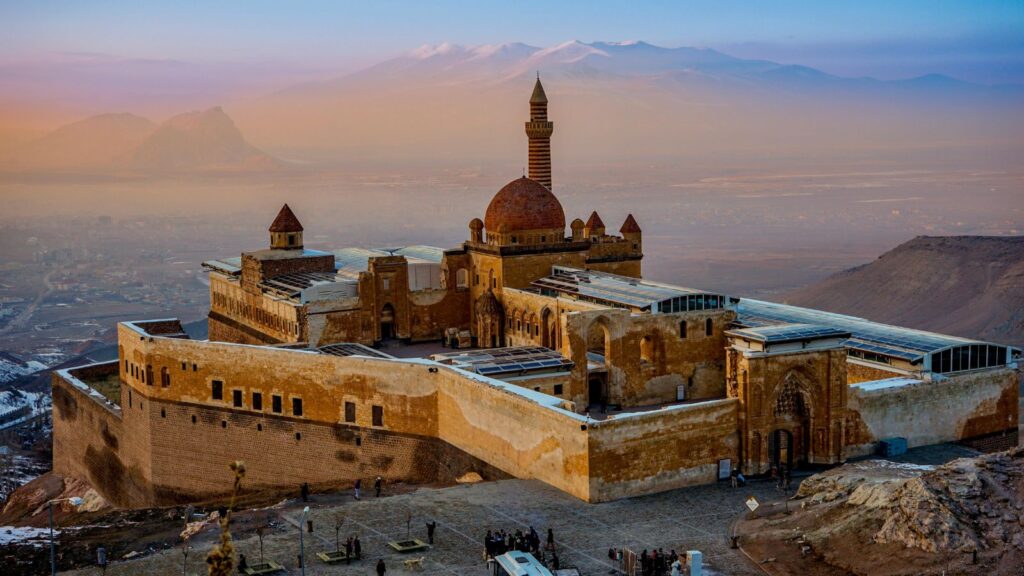
Tucked between the Black and Caspian Seas, wedged against Georgia, Turkey, Iran, and Azerbaijan, Armenia rarely makes anyone’s first-draft bucket list. That’s exactly why it should be on yours. This is a country where 4th-century monasteries cling to cliff edges, where mountain trails wind past shepherds’ villages that have barely changed in a century, and where a glass of homemade wine in a stranger’s cellar is less an activity than a rite of passage. If you’re the kind of traveler who’d rather find a place before the crowds do, Armenia is currently sitting in that sweet spot.
A Landscape Built for Adventure
Armenia packs an outsized amount of terrain into a small footprint. The country is almost entirely mountainous, which means that within a single week you can go from hiking alpine ridgelines to wandering volcanic crater lakes to descending into forested gorges that look more like New Zealand than the Caucasus. Mount Aragats, Armenia’s highest peak, offers a genuine high-altitude trek without requiring technical climbing experience. Further south, the Geghama mountain range is scattered with Bronze Age petroglyphs carved into black volcanic rock — a detail most visitors never even hear about until they’re standing next to one.
For long-distance hikers, the Transcaucasian Trail has become something of a quiet legend. It threads through Armenia’s remote highlands, connecting village guesthouses, alpine meadows, and monastery ruins in a way that rewards slow travel over rushed itineraries. You don’t need to walk the whole thing to get the payoff; even a few days on a section trail delivers views and silence that are hard to find in more heavily trafficked hiking destinations.
History You Can Actually Touch
Armenia was the first nation in the world to adopt Christianity as a state religion, back in 301 AD, and the physical evidence of that history is everywhere. Geghard Monastery, a UNESCO World Heritage Site, is partially carved directly into a mountainside — walk far enough into its chambers and you’re standing inside solid rock, lit only by the light filtering through a domed opening above. Nearby, the pagan temple of Garni stands as one of the only Greco-Roman colonnaded structures left standing anywhere in the former Soviet Union, a strange and striking contrast to the monasteries just down the road.
Then there’s Tatev, reached via the Wings of Tatev cableway — one of the longest reversible aerial tramways in the world — which glides over a dramatic canyon before depositing you at a 9th-century monastic complex that once served as a center of learning for the entire region. It’s the kind of place that makes the journey as memorable as the destination.
Yerevan and the Wine Country
Armenia’s capital, Yerevan, is not a city that asks to be rushed. Its pink volcanic-tuff buildings, wide boulevards, and buzzing open-air markets make it an easy place to wander for days. The Cascade complex — a giant limestone staircase turned open-air art museum — is worth climbing at sunset for the view over the city toward Mount Ararat, Armenia’s spiritual symbol, even though the peak itself now sits just across the border in Turkey.
South of the capital, the Areni wine region has quietly become one of the most compelling reasons to add extra days to an Armenia itinerary. Archaeologists have found what’s believed to be the world’s oldest known winery here, dating back over 6,000 years, and the tradition never stopped. Small family-run wineries still make wine the way their grandparents did, and tastings tend to come with unscripted conversation, homemade cheese, and lavash pulled straight from a clay tonir oven.
When to Go
Armenia rewards different seasons in different ways. Late spring, from May through mid-June, brings mild weather, green valleys, and quiet trails before the summer rush. High summer, June through August, is peak season for serious hiking, paddleboarding on Lake Sevan, and outdoor festivals. Early autumn, September into mid-October, is arguably the most photogenic window of all — golden hillsides, harvest season in the vineyards, and noticeably thinner crowds at the major sites. Winter has its own appeal too, with snow-covered monasteries and a much quieter Yerevan, though some mountain routes become inaccessible.
Getting There and Getting Around
Most travelers fly into Yerevan’s Zvartnots International Airport, which has good connections through major European and Middle Eastern hubs. Citizens of the EU, US, UK, and several other countries can enter visa-free, which removes one of the usual pre-trip headaches. The Armenian dram is the local currency, and while card payments work fine in Yerevan and larger towns, it’s worth carrying cash for smaller villages and family guesthouses. English is widely spoken among younger Armenians, especially in tourism-heavy areas, though learning a few words of Armenian tends to open doors — and dinner invitations — that would otherwise stay closed.
Roads outside the capital can be winding and, in mountain regions, occasionally rough, so a rental car works best for confident drivers who don’t mind unpredictable terrain. For travelers who’d rather skip the logistics entirely, a good local operator can be the difference between a trip that feels like a checklist and one that feels like it was built around you. Several guided Armenia tours are designed specifically around this kind of terrain, pairing hiking routes, monastery visits, and wine country stops with drivers and guides who know which unmarked turn leads to the best viewpoint.
This flexibility matters because Armenia doesn’t fit neatly into one type of trip. Families tend to gravitate toward gentler itineraries built around fortress ruins, cave villages, and short walks near waterfalls, with enough downtime built in for spontaneous stops. Older travelers or those who prefer a slower pace can stick to vehicle-accessible highlights like Khor Virap and Geghard without sacrificing depth. Solo travelers often find Armenia surprisingly easy to navigate independently, while couples looking for something quieter tend to linger longest in Areni’s vineyards and Yerevan’s boutique guesthouses. The point is that Armenia bends to the traveler rather than the other way around — which is part of why it rewards a second visit almost as much as a first.
The Takeaway
Armenia doesn’t announce itself the way better-marketed destinations do. There’s no single iconic photo that gets endlessly recycled across travel feeds, no single beach or ruin that stands in for the whole country. What it offers instead is texture — layers of history, landscape, and hospitality that reveal themselves slowly, usually over a shared meal or a long uphill walk. For travelers who’ve already checked off the obvious adventure destinations and are looking for something that still feels like a discovery, Armenia is worth moving to the top of the list.